Atwater Factors (4-4-9): How to Use Macros to Check Your Nutrition Calculations
Atwater factors, often called the 4-4-9 rule, provide a simple way to estimate the calories contributed by macronutrients. The basic rule is:
- Carbohydrates: 4 calories per gram
- Protein: 4 calories per gram
- Fat: 9 calories per gram

For food manufacturers, the 4-4-9 rule can be a useful sense check when reviewing nutrition label maker calculations. If the calories on a nutrition label don't seem to correspond to the amounts of carbohydrate, protein, and fat, Atwater factors can help identify where to look for an explanation.
In this article, we'll explain how database analysis works, why results can differ from a simple 4-4-9 calculation, and how to diagnose unexpected results.
Does Nutritional Database Analysis Use Atwater Factors?
No, nutritional database analysis starts with the underlying nutrient data for each ingredient derived from lab testing. The nutritional values for each ingredient are scaled to the amount used in the recipe and then added together to produce the nutrition for the finished recipe.
The important point is that the calorie value in a database does not come from applying the 4-4-9 formula to the final carbohydrate, protein, and fat values.
Reliable nutritional databases can contain more detailed information than the basic 4-4-9 calculation accounts for. For this reason, database analysis can produce a more accurate result than simply estimating calories from the macronutrient totals.
Why Might a Database Analysis Differ from 4-4-9?
There are several reasons why the calories from a database analysis may not exactly match a simple 4-4-9 calculation:
1. Rounding on the Nutrition Facts Panel
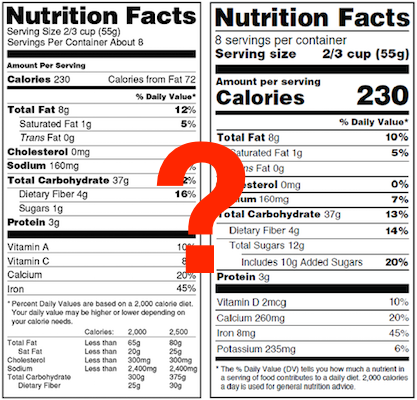
The numbers displayed on a Nutrition Facts panel are presented according to FDA rounding requirements. This means you cannot always work backward from the numbers you see on the label and expect the 4-4-9 calculation to match the displayed calories.
For example, depending on the nutrient and amount, the underlying value may be rounded significantly before it appears on the finished label. When you multiply those rounded numbers by 4 or 9, the result can differ from the actual calculated calories.
Some of the relevant rounding rules include:
- Calories: Less than 5 calories is expressed as 0; 5 to 50 calories is rounded to the nearest 5 calories; more than 50 calories is rounded to the nearest 10 calories.
- Carbohydrate: Less than 0.5 g is expressed as 0; less than 1 g may be expressed as "Less than 1 g"; 1 g or more is rounded to the nearest gram.
- Protein: Less than 0.5 g is expressed as 0; less than 1 g may be expressed as "Less than 1 g" or rounded to 1 g; 1 g or more is rounded to the nearest gram.
- Total fat: Less than 0.5 g is expressed as 0; less than 5 g is rounded to the nearest 0.5 g; 5 g or more is rounded to the nearest gram.
This is why it is important to compare the underlying, unrounded nutrition data when investigating a discrepancy rather than relying only on the numbers displayed on the final label.
2. Not Every Ingredient Follows the Simple 4-4-9 Rule
The 4-4-9 rule is useful, but it does not account for every type of nutrient or ingredient.
Fiber is a good example. Different types of dietary fiber contribute different amounts of energy. Insoluble fiber contributes little or no energy, while some soluble fibers contribute energy. Applying 4 calories per gram to all carbohydrate can therefore overestimate calories in foods that contain significant amounts of fiber, such as bran, oats, and legumes.
Sugar alcohols and rare sugars can also have substantially different energy values. For example, erythritol contributes essentially no calories, while xylitol and sorbitol contribute fewer calories per gram than conventional carbohydrate. Allulose also has a very low caloric value. This can create particularly large differences in products that contain significant amounts of these ingredients, such as some sugar-free and keto products.
Protein and fat can also vary. Plant proteins digest less completely (legume protein is closer to 3.5 kcal/g than 4), and fats range from ~8.3 (MCT/coconut oil) to ~9.0 (animal fat).
Whole foods can behave differently as well. For example, research has found that the metabolizable energy of whole nuts can be lower than what a simple 4-4-9 calculation would predict. The structure of the food can affect how much of its nutrients are actually available for absorption.
There are also nutrients that aren't represented by the basic three-factor calculation. For example, alcohol contributes approximately 7 calories per gram, while certain organic acids can also contribute ~3 calories per gram, but both could get lumped into the carbohydrate category when using 4-4-9.
The result is that using Atwater factors or conducting a database nutrition analysis will not necessarily produce exactly the same results.
3. The Underlying Ingredient Data May Be Inaccurate
While legitimate differences between 4-4-9 and database analysis are important to understand, the quality of the underlying ingredient data is one of the most important things to check when investigating an unexpected result.
Review custom ingredients and user created ingredients. Ingredients created manually can contain data-entry errors or be based on rounded information that will be less accurate. Double check any custom or user created ingredients in your recipe and make sure their nutritional values make sense.
If an ingredient contains a calorie value that is dramatically different from what you would expect, there should be a logical reason for the difference.
How to Evaluate Your Nutrition Results
When you're trying to determine why calories don't appear to follow the 4-4-9 rule, the best approach is to look at the underlying ingredient-level calculations.
In ReciPal, you can do this using the Nutrition Breakdown screen. From the More dropdown, select Nutrition Breakdown.
The Nutrition Breakdown shows the unrounded nutrition contribution from each ingredient, including the grams of carbohydrate, protein, and fat and the calories contributed by each ingredient. ReciPal even includes a specific Macro report.

You can use those numbers to perform a simple 4-4-9 check:
(Carbohydrate grams × 4) + (Protein grams × 4) + (Fat grams × 9) = estimated calories
If the result is close to the calories shown for the ingredient, the 4-4-9 rule is behaving as expected. If there is a significant difference, look at the ingredient and its nutritional profile to determine whether there is a legitimate reason for it.
This ingredient-level approach is much more useful than simply looking at the finished nutrition label because it helps you identify where the difference is coming from.
Using Atwater Factors as a Sense Check
Atwater factors are a useful tool for understanding the relationship between macronutrients and calories. The 4-4-9 rule is simple enough to make it a valuable first check when something about a nutrition calculation doesn't look right.
However, a difference between a database analysis and a simple 4-4-9 calculation does not automatically mean that the database analysis is wrong. Rounding, fiber, sugar alcohols, other energy-yielding nutrients, and differences in the underlying ingredient data can all affect the result.
If you see a significant discrepancy, don't stop at the finished Nutrition Facts panel. Look at the underlying ingredient data and determine which ingredients are contributing to the difference. If the ingredient data is reliable and the difference has a valid nutritional explanation, the database calculation may be more accurate than a simple 4-4-9 estimate.
Ready to take the guesswork out of nutrition calculations? Try ReciPal today!