FDA Nutrition Labeling Guide: Creating a Compliant Food Label
At ReciPal, we've helped food businesses create over 1 million nutrition labels with our easy to use nutrition label maker. Food labeling can be difficult because there are dozens of small rules that all need to work together on the final label.
The problem is that the answers are often scattered across FDA regulations, guidance documents, and industry resources.
This FDA food labeling guide brings together the most important food labeling requirements into one practical reference. We'll walk through the six core elements required on most FDA-regulated food labels, explain the rules behind each one, highlight common mistakes, and share recommendations based on more than a decade of helping food businesses bring successful products to market.
If you prefer to learn over video, we have a high-level version on our YouTube Channel and embedded below:
Food Label Compliance - Anatomy of a Food Label

What is the principal display panel?
The front of your package is called the Principal Display Panel (PDP).

For most food products, this is the area of the package consumers see first when the product is displayed on a shelf.
The FDA requires two key pieces of information to appear on the Principal Display Panel:
What is the information panel?
The information panel is immediately contiguous and to the right of any principal display panel. It contains the other required labeling elements (nutrition facts panel, ingredient statement, allergen declaration, name and place of business).
Everything on the information panel should use a font that is prominent, conspicuous and easy to read. Letters must be at least one sixteenth (1/16) inch in height based on the lower case letter “o”. Additionally, the lettering must contrast sufficiently with the background so as to be easy to read.

It’s important to note that all information appearing on the information panel needs to appear in one place without other intervening material. Food businesses sometimes make the mistake of putting things like storage instructions or branding elements in between required sections of the information panel, which is not allowed.
Food labeling 101: What are the Required Elements of an FDA Food Label?
Most packaged foods regulated by the FDA require six core labeling elements:
- Statement of Identity - The common name of the product
- Net Quantity of Contents - How much is in the package
- Nutrition Facts Panel - The formatted nutritional information
- Ingredient Statement - A list of all ingredients in descending weight order
- Allergen Declaration - A declaration of any of the 9 major allergens present
- Name and Place of Business - Who is responsible for the product
1. Statement of Identity
The Statement of Identity is the common or usual name of your product. Put simply, it tells consumers what the food actually is.

What is a standard of identity?
Some foods have federally defined standards that determine what may legally be called a particular food.
Examples include:
- Mayonnaise
- Peanut Butter
- Ice Cream
These standards specify things such as required ingredients or compositional structure.
For example, a product that doesn't meet the regulatory standard for mayonnaise may need to be called a "sandwich spread" or another descriptive term instead.
This is especially important for businesses developing alternative, reduced-fat, plant-based, or reformulated products.
What if a product doesn't have a standard of identity?
If a standard of identity for the product does not exist then use the common name of the food. In some cases this will be included naturally in the naming of your product, but if not you need to add the common name of the food or an appropriately descriptive name.
Examples include:
- Salsa
- Granola
- Cookies
How do you format the statement of identity?
The statement of identity must be on the principal display panel. The FDA requires that it be in bold type and “in a size reasonably related to the most prominent printed matter.”

As general guidance, they have recommended that this should be at least half the size of the largest print on the label. Further, the text must be parallel to the way the package rests when it is displayed.
What if my product doesn’t fit neatly into an existing category?
When no clear category exists, use an appropriately descriptive term. Do some research to see if there are any conventions among similar products in the market. If no single common name exists, enhance a basic term to give additional context. For example, peach salsa.

🤦♂️ Common Mistake: Confusing the Brand Name with the Statement of Identity
Some first-time food businesses use only their brand name or a creative product name on the front of the package, which is not acceptable. If you make a hot sauce called "Caribbean Fire”, it still needs to say “Hot Sauce” on the label. For example, Dorito's statement of identity is “tortilla chips”. It’s not the flavoring (Nacho Cheese) or the Brand (Doritos) - it’s the core description of the product.
2. Net Quantity of Contents
What Is the Net Quantity Statement?
The Net Quantity Statement is the declaration of the amount of food in a package, expressed in weight, volume, or count. Generally, if the food is solid, semisolid or viscous, it should be expressed in terms of weight. If the food is a liquid it should be expressed in fluid measure (e.g., fl oz).
What are the FDA guidelines for declaring the net quantity statement?
There are many nuances to the net quantity statement. Fortunately, ReciPal provides a free net quantity statement calculator that does all the work for you.
To meet FDA requirements, food businesses must follow these rules when declaring their Net Quantity Statement:
Weight-Based Products: Use ounces and pounds for solids and the term “net weight” or “net wt.”. (e.g., "Net Wt. 8 oz (226g)").
- If the package contains less than 4 pounds, it will be expressed in ounces with pounds in parentheses, if applicable. Example: Net Wt. 24 oz (1 lb 8 oz) 680g
- If the package contains 4 pounds or more, the declaration shall be expressed in pounds with any remainder in terms of ounces or common or decimal fraction of the pound. Example: Net Wt. 5 lb (2.26 kg)

Liquid Products: Use fluid ounces, pints, quarts, or gallons and the term “net” or net contents”. Make sure to distinguish fluid ounces from ounces.
- If the package contains less than 1 gallon, it will be expressed in the largest whole units (quarts, quarts and pints, or pints, as appropriate) with any remainder in terms of fluid ounces. Example: Net 32 fl oz (1 qt) 946 mL
- If the package contains 1 gallon or more, it shall be expressed in the largest whole unit (gallons followed by common fraction or decimal of a gallon or by the next smaller whole unit (quarts, or quarts and pints)). Example: Net Contents 2.5 gallons (9.46L)

How do you format the Net Quantity Statement?
The FDA requires that the net quantity statement must:
- Be placed in the lower 30% of the front panel (also called the principal display panel) and the text needs to be parallel to the base on which the package rests.
- Display U.S. customary and optionally metric units (e.g., "Net Wt. 16 oz (454g)" or "Net 12 fl oz (355mL)").
- Be prominent and legible, with font size requirements based on package size.

🤦♂️ Common Mistake: Confusing Package Volume with Weight
Sometimes food manufacturers wrongly use the volume of their packaging container as its weight. Just because you're using an 8 oz bottle doesn't mean the weight of your contents is 8 oz.
Below is an example of Trader Joe’s spices which all use the same size bottle, but each have a different net weight.
.png)
3. Nutrition Facts Panel
The nutrition facts panel is the most complicated part of the labeling process. It tells consumers what nutrients are in their food and shows them nutritional information on calories, fat, sugar, protein, and vitamins in a food so that they can decide what to eat. If you need help creating a nutrition fact panel, ReciPal's nutrition label software calculates nutrient values and applies all FDA formatting and rounding rules automatically.
When are nutrition facts required?
Nutrition facts panels can be optional for small businesses that qualify for exemptions, but for most businesses they will be required. Nutrition labels are required if any of the following are true:
- You make any claims about your product (e.g. "High in fiber", "Low fat", etc.)
- You have more than $50,000 of food sales AND more than $500,000 of total sales
- You plan to sell your product in almost any grocery store or large online marketplace (e.g. Amazon). If the store in question meets the sales threshold then any product they carry must have nutrition labeling.
- Businesses with more than 100 full-time equivalent employees (FTEs) OR sales of more than 100,000 units of a product.
What are the required elements of a nutrition fact panel?

Nutrition facts requirements:
- The serving size and number of servings in the container
- The calories per serving (and per container if you have 2-3 servings in your package)
- Total fat
- Saturated fat
- Trans fat
- Cholesterol
- Sodium
- Total carbohydrates
- Fiber
- Sugar
- Added sugar
- Protein
- Vitamin D
- Calcium
- Iron
- Potassium
- The actual value for the amount of each nutrient
- The percentage of the daily recommended value of that nutrient the serving provides. This is not shown for trans fat and total sugars. Protein, is often optional, but if you make protein claims or make labels for infants (age 0 to 12 months) and children (age 1 to 3 years) it's required.
You’re also allowed to include information for other nutrients like sugar alcohols and unsaturated fats or for vitamins and minerals you might want to highlight in your product, like Vitamin C and A, Magnesium, and Zinc, and more.
Remember, optional nutrients are required if you’re making a claim about them.
💪 ReciPal Tip - If certain nutrients are present in insignificant amounts you are allowed to use the simplified format. The simplified format may list as little as 5 major nutrients.

How do you determine the serving size on a nutrition label?
The FDA requires the serving size be listed as a common household measure on nutrition fact panels.
A common household measure refers to things like 1 bar, 1 cookie, 1 bag, 1 cup, 1 tbsp etc. This type of labeling makes it easier for the average consumer to visualize what a serving size actually is. So that similar foods are comparable to the consumer, the FDA has designated reference serving sizes and serving size descriptions across most categories.
We've found that the serving size often leads to mistakes on nutrition labels. ReciPal has a free FDA serving size finder tool that helps you identify the correct food category and automatically set the right serving size to ensure food label compliance. We have a dedicated blog with more info on determining serving size within ReciPal.
The FDA has three main distinctions for food products that dictate how the serving size should be determined and listed:
- Discrete Units - this refers to products like muffins, sliced bread, or individually packaged products within a multi serving package.
- Divided Products - this refers to large discrete units that are typically divided for consumption like cakes, pies, pizzas, and melons.
- Bulk Products - this refers to non-discrete products like breakfast cereal, flour, sugar, and pancake mix.
How do you determine serving size for discrete units?
For discrete units, the number of units that comes closest to the reference amount is the serving size. For example, the reference amount for cookies is 30 grams and the suggested label statement is __ piece(s). So if one cookie weighs 10 grams, the suggested serving size would be 3 cookies.
- Reference amount / unit weight = serving size
- 30g / 10g = 3 cookies
- Note: The FDA says that the term “piece” is a generic description of a discrete unit, but you should use the description of a unit that is most appropriate for the specific product (so in this case we’d use “cookies” instead of pieces).
For discrete units, there are rounding rules based on the unit weight to RACC percentage. So the first thing you have to do is figure out the percentage a unit makes up of the reference amount.
Percentage of Reference Amount = (Unit Weight / RACC) * 100
- ≤ 50%: Round to the nearest whole number
- >50% and <67%: You can declare either one or two units as the serving size
- ≥ 67% and < 200%: Serving size must be declared as one unit
- ≥ 200% and ≤ 300%: Serving size must be the proportion of the unit that is closest to the reference amount. A dual column label is required if servings per container is between 2 and 3.

How do you determine serving size for divided products?
For divided products, the serving size is the fractional slice of the product. For example, the reference amount for pie is 125 grams and the suggested label statement is __ fractional slice. So if a pie weighs 500 grams, the suggested serving size would be ¼ slice.
- Reference amount / unit weight = serving size
- 125g / 500g = 0.25 = ¼ slice
For divided products, when expressing the fractional slice, manufacturers need to use 1⁄2, 1⁄3, 1⁄4, 1⁄5, 1⁄6, or smaller fractions that can be generated by further division by 2 or 3.

How do you determine serving size for bulk products?
- For bulk products, the serving size is the amount in household measure (i.e. cup, tbsp, tsp) that most closely approximates the reference amount. For example, the reference amount for yogurt is 170 grams and the suggested label statement is ___ cups. So if 1 cup of yogurt weighs 340 grams, the suggested serving size would be ½ cup.
- Reference amount / weight of 1 common measure unit = serving size
- 170g / 340g = 0.5 = ½ cup
For bulk products, cups, tablespoons, or teaspoons shall be used wherever possible and appropriate except for beverages. For beverages, a manufacturer may use fluid ounces.
- Cups shall be expressed in 1/4- or 1/3-cup increments.
- Tablespoons shall be expressed as 1, 1 1/3, 1 1/2, 1 2/3, 2, or 3 tablespoons.
- Teaspoons shall be expressed as 1/8, 1/4, 1/2, 3/4, 1, or 2 teaspoons.
Now there’s also the situation where the serving size is a fixed volume amount. For example, the suggested serving size of ice cream is ⅔ cup. In this case, the FDA is giving you the serving size and the only thing you need to figure out is what ⅔ cup of your ice cream actually weighs.

What if the FDA doesn’t address your product category?
Even though it’s the suggested serving size, for the most part, it’s not up to the food manufacturer to determine what that suggestion is. As we’ve seen, the serving size is informed by a clear set of guidelines provided by the FDA. However, there are certainly cases when your product category may not exist or be clearly delineated by the documentation. In these cases, it makes sense to look for categories most analogous to your own product and use your best judgment.
🤦♂️ Common Mistake - Assuming you get to determine a serving size
Many food businesses don’t realize that the serving size isn’t something they get to set. Make sure to look at FDA reference amounts for your food category to abide by their standards.
How do you determine the number of serving per container?
You can calculate the number of servings per container by dividing the weight of a serving by the net weight per package (or volume in the case of volume-based products). The number of servings in your package also gets rounded.
Servings Per Container | Rounding Rule |
|---|---|
<2 Servings Per Container | Should be a Single Serving Per Container |
2-5 Servings Per Container | Round to nearest 0.5 Servings |
>5 Servings Per Container | Round to nearest 1 Serving Per Container |
If you have 2 -3 serving per container you are required to use a dual column format label that shows the nutrition per serving and per container.

Additionally, if your servings per container is not a whole number then you need to indicate “About X servings per container.”
For example, the serving size for hot sauce is 1 tsp (5 mL). A 5 fl oz bottle has 147.8 mL. Because 147.8 mL ÷ 5 mL/serving = 29.56 servings, the label should say “About 30 servings per container”.
💪ReciPal Tip: If you have a single serving container you are allowed to omit the servings per container section as long the serving description is clear (e.g. 1 box, 1 container).

How are nutrition facts calculated?
The FDA has two acceptable methods to calculate nutrition facts. You can either have your product lab tested or conduct a database nutrition analysis. Both of these methods provide accurate results, but lab testing is significantly more expensive, time consuming, and cannot easily adjust for recipe or process changes.
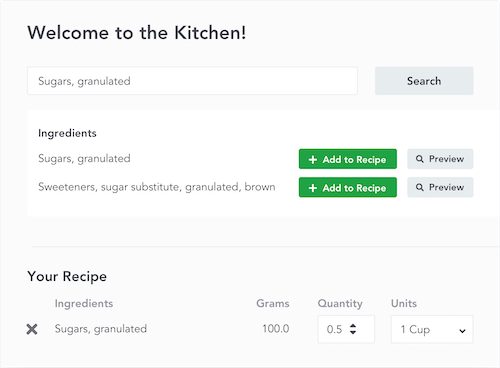
Database analysis programs like ReciPal use existing lab tested values of ingredients. You search the database for ingredients, select the amount you use in your recipe, and tell the system what the recipe yields. All the calculations are done for you instantly, aggregating the nutritional information and applying the proper rounding and formatting rules.
What are the rounding rules for nutrition labels?
The rounding rules for nutrition labels are quite extensive. Thankfully, ReciPal's nutrition label maker can apply all of these rules for you automatically.
Rounding Major Nutrients
For the main nutrients in the panel--calories, fat, protein, carbs, etc.--the rules look like this:
Nutrient | Rounding Rule |
|---|---|
Calories | <5 round to 0; ≤50 round to nearest 5 cal; >50 round to nearest 10 cal |
All Fats (Total Fat, Saturated Fat, Trans Fat, Poly and Monounsaturated Fat | <0.5 g round to 0; <5 g round to nearest 0.5 g; ≥5 g round to nearest 1 g |
Cholesterol | < 2 mg round to 0; 2-5 mg show as "less than 5 mg"; >5 mg round to nearest 5 mg |
Sodium | <5 mg round to 0; 5-140 mg round to the nearest 5 mg; >140 mg round to the nearest 10 mg |
All Carbohydrates (Total Carbs, Dietary Fiber, Sugar, Added Sugar, Sugar Alcohol) | <0.5 g round to 0; <1 g show as "less than 1 g"; ≥1 g round to the nearest 1 g |
Protein | <0.5 g round to 0; <1 g show as "less than 1 g" or round to 1 g; ≥1 g round to the nearest 1 g |
Rounding Percent Daily Value
% DV | Rounding Rule |
|---|---|
All Nutrients Except Vitamins and Minerals | round to nearest 1% |
Vitamins and Minerals | ≤10% RDI round to nearest 2% DV; >10%-50% RDI round to nearest 5% DV; >50% round to nearest 10% DV |
Quantitative Vitamin Rounding
Mandatory Vitamin/Mineral Quantitative Amount | Rounding Rule |
|---|---|
Calcium | Nearest 10 mg |
Iron | Nearest 0.1 mg |
Vitamin D | Nearest 0.1 mcg |
Potassium | Nearest 10 mg |
Optional Vitamin/Mineral Quantitative Amount | Rounding Rule |
|---|---|
Thiamin, Riboflavin, B6, B12, Copper, Manganese | Nearest 0.01 mg or mcg |
Vit. E, Niacin, Biotin, Pantothenic acid, Zinc, Chromium, Molybdenum | Nearest 0.1 mg or mcg |
Vit. C, Vit. K, Iodine, Selenium | Nearest 1 mg or mcg |
Folate, Magnesium | Nearest 5 mg or mcg |
Vit. A, Phosphorus, Chloride, Choline | Nearest 10 mg or mcg |
What font do FDA Labels use?
The FDA requires that: "The nutrition label shall utilize a single easy-to-read type style."
While no specific font is required or prescribed by the FDA, they use Helvetica in their examples and so do most labels. As a result, this has become an industry standard, making labels that use other fonts look a bit unprofessional despite being completely acceptable as far as the FDA is concerned. For customers reading labels, the Helvetica font is easier to recognize and makes the label and layout feel familiar and easy to follow.
What are the design guidelines for nutrition facts panels?
There are many detailed rules for the design of nutrition facts panels as shown in the image below. Different sections have their own sizing, spacing, and layout requirements. ReciPal automatically applies all of the formatting rules for you, but if you decide to take on the design of the label yourself then you or your designer needs to pay close attention that every rule is followed.

What label format should I choose?
There are three primary nutrition label formats: vertical, tabular, and linear.

- If you have space for the vertical label on your packaging, use the vertical label
- If you don't, then try the tabular label
- If there isn't space for the tabular label, use the linear label
The main factor determining the label format is "total area available to bear labeling".
- If you have more than 40 square inches available you must use the vertical label, provided that you have vertical space to fit it up to and including the declaration of vitamins (approximately 3 inches). There is a footnote at the bottom of the vertical label that can be removed if you don't have space for it. Removing the footnote is an option if you have less than 40 square inches available.
- If you have more than 40 square inches available but don't have the vertical space to fit the vertical label, you should use the full tabular nutrition label format. If you have less than 40 square inches available, the tabular nutrition label format can be used with the footnote removed, saving a bit of horizontal space.
- If you have less than 40 square inches available and your packaging can't accommodate either the vertical or tabular labels, you can use the linear label. Furthermore, the nutrient names can be abbreviated to save further space.
- If you have less than 12 square inches available and do not make any nutrient claims on your packaging, you may omit the nutrition fact label entirely. However, you must provide a contact (address or telephone) for consumers to inquire about nutritional information.
What nutritional claims am I allowed to make?
Nutritional content claims aren't required on your food packaging, but can help market your product. To make a nutritional claim you need to meet the FDA defined threshold for the specific category. In general:
- "High" claims - require that the food contains 20 percent or more of the RDI per reference amount customarily consumed. For example, if you wanted to claim that a product was an "excellent source of protein" it would need to have at least 20% the reference daily intake. Since the RDI of protein is 50g, a serving would need at least 10g of protein to qualify.
- "Good Source" claims - require that the food contains 10 to 19 percent of the RDI or the DRV per reference amount customarily consumed. For example, if you wanted to claim that a product "contains protein" it would need to have at least 10% the reference daily intake. Since the RDI of protein is 50g, a serving would need at least 5g of protein to qualify.
- "Low" claims - depend on both the amount of the nutrient and the reference amount of the food. For example "low sodium" may be used if the food has a reference amount customarily consumed greater than 30 g or greater than 2 tablespoons and contains 140 mg or less sodium per reference amount customarily consumed.
- "Free" claims - depend on both on the amount of nutrient and the reference amount of the food. For example, the term "fat free" may be used if foods contain less than 0.5 gram (g) of fat per reference amount customarily consumed and per labeled serving.
Before making any claim, make sure to look into all the details to ensure your product qualifies. There are often supplemental requirements.
4. Ingredient Statement
An FDA ingredient statement (or ingredient list) is the required declaration of all ingredients in a packaged food.
What are the requirements for an FDA ingredient list?
The most important part of an ingredient statement is to list each ingredient in descending weight order. That means the most prevalent ingredient goes first, and the ingredient you use the least of in your recipe goes last. Remember that this is based on weight, not volume. If you're using ReciPal, ingredients will automatically be listed in the correct order based on your recipe.
.png)
Ingredients should be listed using their "common" names. The example the FDA provides is to use "sugar" instead of "sucrose".
If any ingredient has its own list of sub-ingredients, those sub-ingredients should be listed in parentheses. As an example, if your recipe uses packaged tomato sauce, you would list each ingredient, and then when tomato sauce comes up you'd list it something like "Tomato Sauce (Tomato Puree (Water, Tomato Paste), Water, Less than 2% of: Salt, Citric Acid, Spice, Tomato Fiber, Natural Flavor)".
Are there any other formatting rules or options?
- Ingredients that are 2% or less of the whole recipe (by weight) do not have to be listed in descending weight order. They can be placed at the end of the ingredient list following a statement like "Contains 2% or less of ..." or "Less than 2% of ...".
- Certain spices do not have to be declared by name, but can be listed in aggregate and declared simply as "spices". So, if your recipe has cinnamon, black pepper, and ginger you can list them all together as "spices". This can be good if you're trying to condense your ingredient statement.
- Chemical preservatives must also be included along with the function they serve in the recipe, such as "preservative", "a mold inhibitor", "to promote color retention", and a few others. For example, ascorbic acid might be listed as "Ascorbic acid to promote color retention".
How do you format an ingredient statement?
It's generally just text laid out below the nutrition label, but there are a few rules to follow.
The font must be legible and easy to read. The benchmark is that the lowercase letter "o" has to be at least 1/16th of an inch.
You are also allowed to use bolding in the ingredient statement, which can be particularly useful to for readability. By bolding the main ingredients they stand out from the subcomponents.
🤦♂️ Common Mistake - Omitting Sub-ingredients
If you’re using pre-packaged ingredients you need to include their entire ingredient list. For example, if you use M&Ms in a cookie, FDA rules require you to list every subingredient that makes up the M&Ms—including colors, emulsifiers, and flavors.

5. Allergen Declaration
What does the FDA classify as allergens?
The FDA classifies 9 Major Food Allergens:
- Milk
- Eggs
- Fish (e.g., bass, flounder, cod)
- Crustacean shellfish (e.g., crab, lobster, shrimp)
- Tree nuts (e.g., almond, walnut, pecan)
- Peanuts
- Wheat
- Soybeans
- Sesame
How do you declare allergens on a nutrition label?
Allergens must be declared in plain, common language, either:
- In parentheses after the ingredient (e.g., whey (milk)), or
- In a separate “Contains” statement immediately after the ingredient list (e.g., Contains: Milk, Soy, Wheat).
Source Identification
Some categories of allergens require additional specification. For fish, shellfish, and tree nuts, the specific type must be named:
- Fish: e.g., “salmon”
- Tree nuts: e.g., “almond,” “pecan”
- Shellfish: e.g., “shrimp,” “crab”

For the most part, any amount of an allergen must be declared. However there are some exemptions for incidental additives that are present in a food at insignificant levels and do not have any technical or functional effect in that food.
ReciPal takes care of allergens for you with our automated allergen feature.
Are potential cross-contamination statements required?
Though they are widely used and considered a best practice, these precautionary allergen statements (e.g., “May contain peanuts” or “Manufactured on equipment that processes soy”) are voluntary and not required by law. If they are used, they must be truthful and not misleading.
However, they are widely used and must be truthful and not misleading.
🤦♂️ Common Mistakes - Failing to indicate the specific type of allergen for broad categories
It’s not enough to let consumers know that your product contains tree nuts. To stay compliant you need to list the specific types of tree nuts present (walnuts, cashews, etc.).
6. Name and Place of Business
Why do you need the name and place of business on your label?
The point of this requirement is to allow people to find your physical place of business, not to contact you. So you cannot use a P.O. Box to fulfill this requirement. The address has to be a physical location. Every package needs to have an address!
You can provide different general contact information somewhere else, but you still have to give the location of your business to satisfy the FDA requirements. If your principal place of business is different from where you manufacture, pack, or distribute your food, you can use your main business address on the label as long as that won't be misleading.
How do you state the name and place of your business?
You have to state the actual corporate name of either the manufacturer, packer, or distributor. If you're an individual, partnership, or association, you show the name under which you conduct your business. If you're the manufacturer of your product, you don't need any qualifying description to go with your name. Otherwise you need to explain the relationship of the business to the product by saying "manufactured by" or "distributed by" or "packaged by."
.png)
What does the address need to include?
The address must include the city, state, and zip code of the primary location of the business. If your business is listed in a common directory and can be easily found that way, you don't need to include a street address. But if it can't be found that way, either because it's not in the directory or because you have multiple locations and it's not obvious which is the primary place of business, you are required to include a street address (street number and name, suite or building number, etc.). This is where that post office box won't work.
🤦♂️ Common Mistake - omitting street address
You are only allowed to omit the street address if your business address can be found in a common directory. If that’s not the case, the full address is required.
Make an FDA Compliant Food Label With ReciPal
Creating FDA compliant food labels requires extreme attention to detail. Every element—from serving sizes and ingredient statements to allergen declarations and net quantity statements—must work together to satisfy FDA requirements. While the regulations can be complex, the right nutrition label software can make the process significantly easier. ReciPal handles FDA label formatting, rounding rules, ingredient statements, and allergens automatically — and you can get started for free.
See how it works
ReciPal is a top-rated platform that has been trusted by brands of all sizes for over 15 years. Whether you're developing your first product or managing an established product line, ReciPal helps streamline nutrition analysis, label creation, recipe costing, and inventory management so you can spend less time navigating regulations and more time growing your business.