Nutrition Labeling For Spice Blends
At ReciPal, lots of food businesses use our software to label their signature spice blends. Spices might seem simple when it comes to labeling, but there are a few nuances worth understanding to make sure your labels are accurate, compliant, and professional.
Below are key insights to keep in mind when creating labels for spices and spice blends.

Do You Even Need an Ingredient List or Nutrition Panel?
Ingredient Lists
For single-ingredient spices, you often don’t need an ingredient list. The front of the package just needs a statement of identity (e.g., “Ground Cinnamon”), which makes an ingredient list redundant.
For spice blends, you can group many items under the generic term “spices.” But there are exceptions:
- Ingredients traditionally used as foods themselves like onion, garlic, or celery must be listed by name.
- Salt, monosodium glutamate (MSG), and artificial smoke flavors must also be declared.
Example:
INGREDIENTS: Salt, Jalapeño Pepper, Spices, and Onion Powder
Nutrition Facts Panels
A Nutrition Facts label is not required for spices if they contain insignificant amounts of all of the nutrients and food components. Insignificant is defined as:
- For total carbohydrate, dietary fiber, and protein, it shall be an amount that allows a declaration of “less than 1 gram.”.
- For all other components, it is the amount that allows a declaration of zero in nutrition labeling.
However, if you make any nutritional claims about your product you'll always need a nutrition fact panel.
Expect Minimal Nutrition Data
Most spices don’t show much nutrition per serving. That’s not because they’re unhealthy—it’s due to the small serving size - ¼ teaspoon or 0.5 g if not measurable by teaspoon - and FDA rounding rules.
With such tiny amounts, many nutrients round down to zero, which means your Nutrition Facts panel will likely look pretty bare. This is to be expected.

Use the Best Ingredient Data
Accuracy starts with ingredient data. Whenever possible:
- Choose USDA database ingredients in ReciPal.
- For custom ingredients, use unrounded data from a supplier’s spec sheet. You can automatically create an custom ingredient from a spec sheet with our AI ingredient creation tool.
Avoid relying solely on another product’s rounded nutrition panel, since those values are often based on 0.5 g servings where most everything rounds to zero. A spec sheet gives you precise numbers, normally based on 100g of the ingredient that make for a more accurate final label.
Choose the Right Label Format
Spice packaging is usually small, so label space is at a premium. If you need to include a Nutrition Facts panel, the linear format or simplified vertical format are often the best fit. You can find more info in our detailed guide on label choices.

You can use the linear style when:
- Packaging has less than 40 square inches of space, and
- Vertical or tabular formats won’t work.
Moisture Loss and Waste
Here’s some good news: spice blends are usually straightforward in terms of yield.
- No cooking, trimming, or marinating means that waste and moisture loss are typically 0%, giving you a 100% yield.
- If your process does involve any loss, just document it clearly so it makes sense in your recipe and labeling. We've got a detailed blog on moisture loss if you're interested in learning more.
Don’t Forget the Basics
While some spice labels don't need an ingredient list or nutrition fact panel, there are still required nutrition labeling elements.Every spice label must include:
- Statement of Identity (what the product is, e.g., “Cajun Spice Blend”)
- Net Quantity Statement (weight of the product in the package)
- Business Name and Address
Net Quantity Statement Tip
Container size can be misleading. A “2 oz spice jar” refers to volume, not weight. The actual weight of spices varies depending on density, so don’t assume—it’s essential to weigh your product to declare the correct net weight.

ReciPal Features Make It Easier
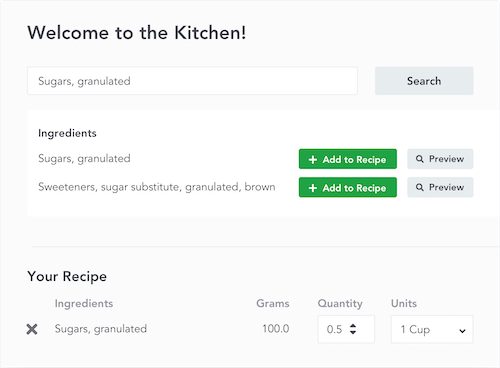
Not sure yet what size container you’ll use? You can set up a recipe based on the proportions of ingredients. Start your recipe with a 100 g batch (100% yield) so that the grams of each ingredient represents the percentage it makes up of the recipe. Then select to set up your recipe by "Serving Size". This makes setting up the actual packaging easy later on. When you're ready, simply adjust the servings per container to whatever package size you're using.

Final Thoughts
Spice blends are an exciting category. They let you share a bit of culture, tradition, or creativity in a simple sprinkle that elevates everyday meals. With the right approach to ingredient data, compliance rules, and packaging details, you’ll be confident your labels are accurate and ready for market.